Devontae Patterson
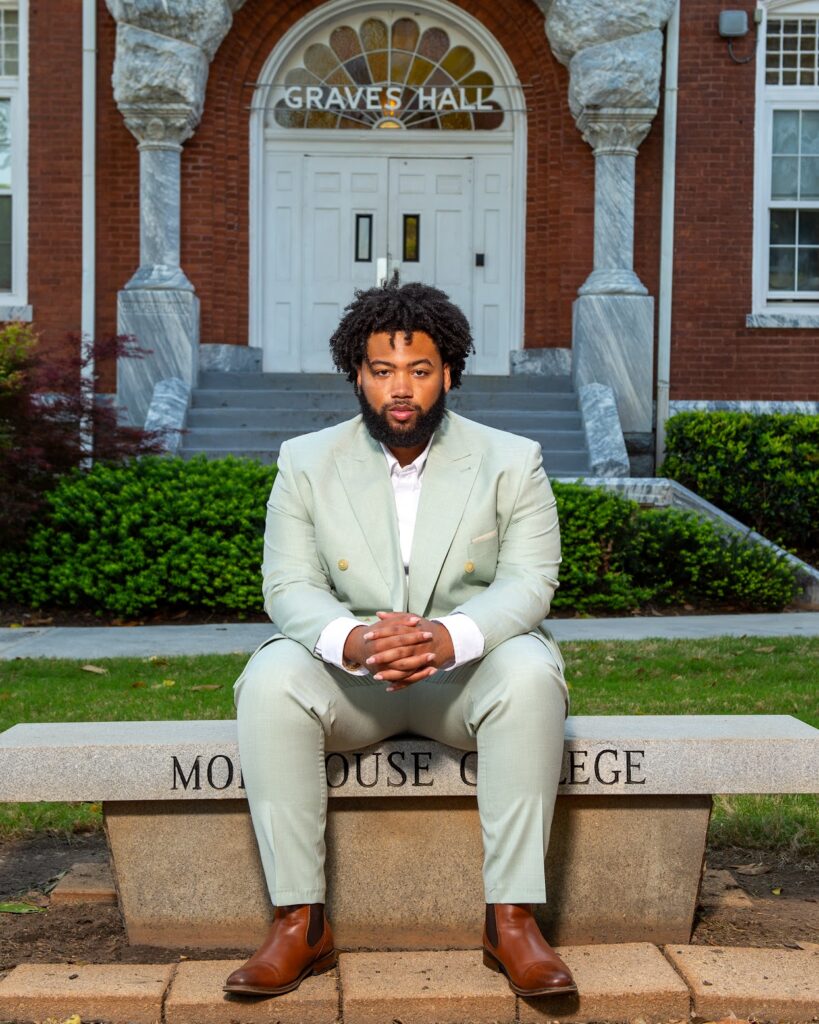
What makes me who I am
I am a Black man shaped by place, history, and purpose.
Being born and raised in Houston, Texas, gave me grit, pride, and an unshakable sense of identity. Houston taught me how to move through the world with confidence, how to stand tall in spaces that were not built for me, and how to survive in systems that were never designed to protect me. It gave me culture, community, resilience, and voice. But it also showed me early what it means to be seen as a threat before being seen as a human.
Coming from Houston and then choosing to attend an HBCU in Atlanta changed my life in ways I did not fully understand at first. Stepping onto Morehouse and Spelman’s campus meant stepping into a space where my Blackness was not something I had to explain, defend, or dilute. For the first time, I was surrounded by Black excellence, Black leadership, Black intelligence, and Black ambition on every level. Atlanta gave me vision. Morehouse gave me language. And together, they helped me understand myself not just as a Black man trying to survive the world, but as a Black man meant to change it.
Living as a Black man in America means carrying an awareness that never turns off. It means knowing that injustice is not an abstract idea; it is a daily reality. It is in traffic stops. It is in classrooms. It is in job interviews. It is in courtrooms. It is in the headlines. It is in silence. It is in fear. Black men are forced to navigate a country where our bodies are politicized, our voices are criminalized, and our existence is constantly questioned. The injustice we face is not rare; it is routine.
I see these parallels in myself, and I see them in Trayvon Martin. A young Black boy who was simply existing. Simply walking. Simply being. Yet his life became a symbol of how disposable Black lives are treated in this country. When I look at his story, I do not see a headline; I see reflection. I see a possibility. I see vulnerability. I see how easily my own life could be reduced to a statistic, a hashtag, a moment of outrage followed by silence.
Sometimes I think about history and where I would have stood. And I know without hesitation that if I had been born in the era of the Black Panther Party, I would have joined. Not for violence. Not for chaos. But for the community. For education. For protection. For empowerment. For the belief that Black people deserve access, dignity, safety, and self-determination. The Panthers represented organization, discipline, knowledge, and collective power, and that ideology still lives in me today.
Fred Hampton’s story lives in me, too. A young, brilliant Black leader. Educated. Strategic. Powerful. Unifying. A man who built coalitions, organized communities, and spoke truth. And for that, he was silenced. Shot by police. Murdered not because he was dangerous, but because he was influential. Because he had a voice. Because he had vision. Because he had the power to awaken people.
History has shown us a pattern: Black men who gain education, influence, and a platform are often silenced before they can fully build what they were meant to create for their people. But that reality does not make me fearful. It makes me focused.
I exist to be part of a different legacy.
One where Black men are not just surviving systems, but transforming them. One where we build for ourselves. One where we build for our communities. One where our voices are not erased. One where our leadership is not criminalized. One where our power is not feared, but respected.
My life is not just about personal success. It is about collective impact. It is about representation. It is about responsibility. It is about legacy.
I am a product of Houston. I am a product of HBCU culture. I am a product of Black history. And I am committed to building a future where Black men are not just remembered for how they were silenced, but for how they changed the world.
Follow and connect with me on Social Platforms
Thank you.